
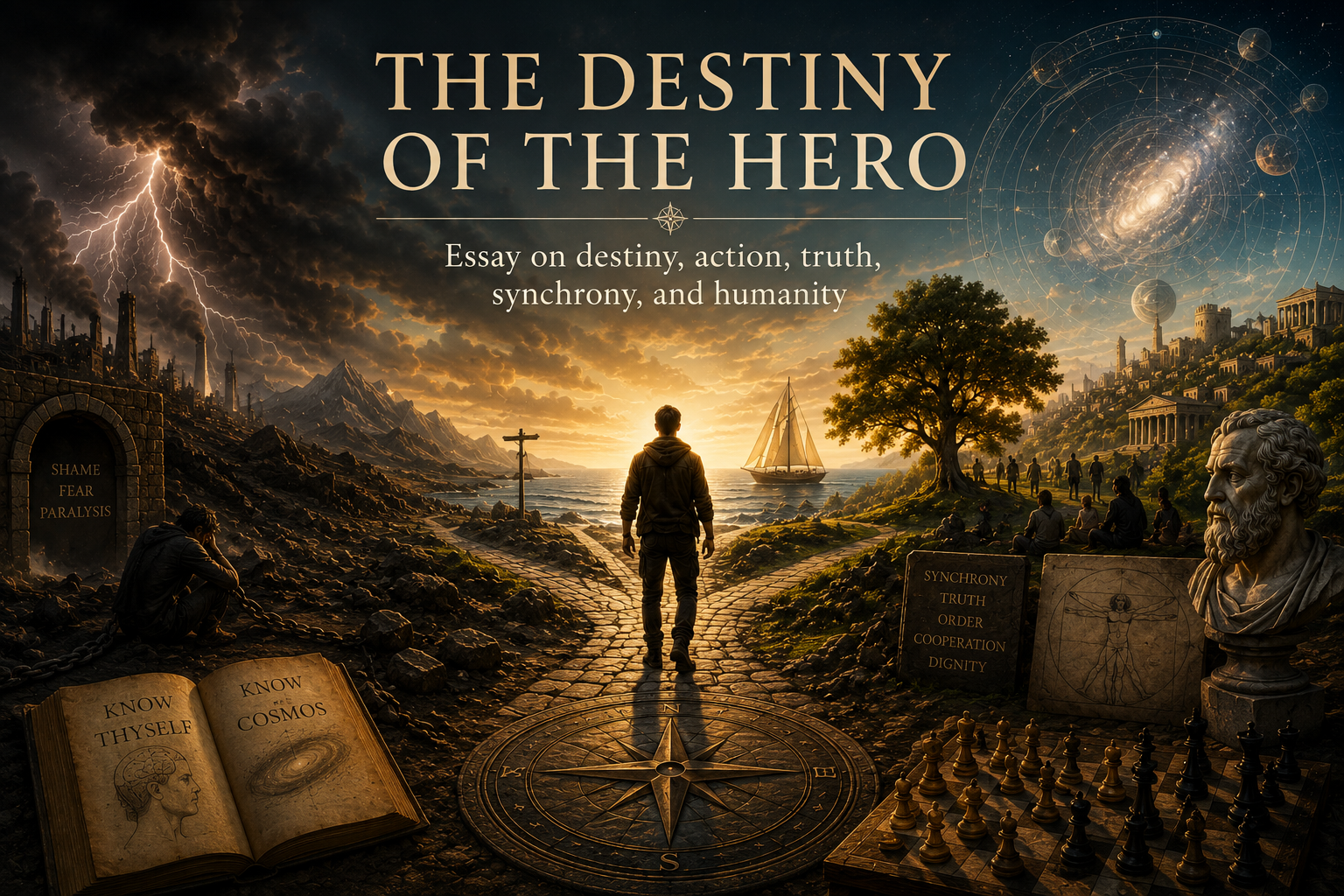
Essay on destiny, action, truth, synchrony, and humanity
I. Point of Departure
Every human being is born within a fabric they have not chosen. No one decides their genes, their innate temperament, their family, their era, their place, their language, their first wounds, or the general framework of their circumstances. Every life begins already situated: thrown into a concrete combination of limits, possibilities, talents, and defects. Human existence does not begin from absolute freedom, but from a prior configuration. Life does not begin with a blank page, but with a text already started, with a determined biological hardware and software, thrown into a concrete time and space.
At the same time, every human being is the hero of their own tragicomedy. The human being is not a passive piece, an object, an empty puppet, a mere powerless spectator of their own story. The received condition does not eliminate action; it makes it possible. Every human being is a node that arises from a collapse of possibilities into an act. In this sense, destiny does not replace the individual: it manifests itself in them, passes through them, and is realized through their deeds. The human being is the place, the conscious process where necessity becomes experience, suffering, pleasure, decision, knowledge, struggle, and responsibility lived in the first person; it is the subjectivization of potency becoming conscious act.
For this reason, it may be affirmed, without contradiction, that every individual is the hero of their own adventure. Not because they are the absolute author of the script, but because they are its conscious protagonist. Not because they control the totality, but because they embody from within an unrepeatable trajectory. The greatness of human life does not consist in inventing oneself from nothing, but in interpreting in the best possible way the concrete form of existence that has been given to each person. Every human being is the captain of their sailboat on the sea of their circumstances, and their decisions condition, together with that sea, the port at which they will arrive. For this reason, life must be lived as if we were condemned to repeat it, not because perhaps that is so, but because only in that way is it worthy of being lived. The final question on one’s deathbed should not be whether one regrets this or that sin, but: “Would you repeat your life?”
II. The Hero Does Not Choose the World, but Does Embody It
The image of the hero becomes distorted when it is confused with the fantasy of total sovereignty. The true hero is not the one who absolutely dominates circumstances, but the one who responds to them with the greatest possible intensity of being. It is not the one who dictates all the conditions of the battle, but the one who fights with lucidity within those that have fallen to them. The human adventure does not consist in having an unlimited field of choices, but in converting the received circumstance into an achieved form of existence, increasing the coherence between the inner and the outer.
Our task is not to endlessly lament what has been given to us, envying others or searching for those to blame for our misfortunes, but to unfold it in the best possible way.
On the other hand, absolute resignation is another bad reading of destiny, because it forgets that destiny includes and requires effort, vital impulse.
Likewise, the arrogance of believing oneself better simply because one has superior life conditions, or of despising those who have inferior conditions to one’s own, is another terrible reading, because it forgets that your very effort itself is born within a network of causes that precedes you.
The just position lies elsewhere: destiny exists, but it is lived as action. What is written does not happen apart from you, but in you and through you. If you do nothing, that not-doing will also produce its consequences. If you struggle, that struggle equally forms part of the real and will open other trajectories. For this reason, there is a deep convergence between necessity and deed. The human being is not the master of destiny, but they are its agent, its embodiment, its necessary node.
III. Shame, Paralysis, Fear, and Lost Time
If human life is action that unfolds embodied within a necessary fabric, then three of the most common losses of vital energy are sterile shame about the past, paralyzing fear of the future, and analytical paralysis before the present. Shame only has value when it is transformed into a means of learning and correction. Fear only has meaning when it becomes lucid foresight. Outside that, both are forms of dispersion.
There is no sense in remaining fixed on past errors as if unproductive remorse could remake what has already occurred. The past is not corrected by emotionally inhabiting it without end, but by integrating it as knowledge into our wisdom. In the same way, there is no sense in living by obsessively anticipating every possible evil of the future, as if accumulated fear could guarantee control. The future is not governed by anguish, but by preparation, discipline, and present truth. Finally, neither can we remain in a perpetual present: analyzing the different variables in order to make a decision is wise, but paralysis by analysis obstructs action, obstructs life.
The hero of their own adventure is not the one who does not fall, but the one who falls, rises, and learns. It is not the one who lives free of pain, but the one who metabolizes pain into understanding and, therefore, increases their wisdom. Life demands review, readjustment, rectification. Whoever clings to useless guilt, shapeless fear, or paralyzing analysis loses ontological time: they waste the concrete point from which they can still act. And the only point from which a life can be fulfilled is always the present.
IV. Knowing Oneself and the Cosmos
The good life does not depend primarily on material abundance or on the intensity of desire and its satisfaction, but on the quality of the knowledge acquired and on its systemic ordering into wisdom, as a conceptual-ontological framework for action. To act correctly is not to do whatever pleases one at every instant, but to act in a way adjusted to reality, taking into account past, present, and future. And for this, it is necessary to study two things: oneself and the cosmos.
To know oneself means to understand one’s own composition: desires, wounds, passions, habits, biases, capacities, limits, fears, automatisms, real and not imaginary priorities. Whoever does not know themselves acts blindly. They confuse impulse and automatism with truth, habit with identity, whim with destiny. They misinterpret themselves and therefore choose badly.
But self-knowledge is not enough. It is also necessary to study the cosmos: objective reality, the nature of things, their mechanics, causal chains, the place of the human being and of humanity within the whole, the foreseeable consequences of acts, the forms of order and disorder that run through existence.
Wisdom is born from the coupling between both forms of understanding. The more faithful the image we have of ourselves and of the universe, the straighter our action can be. For this reason, the difference between acting well or badly, in a holistic sense, depends largely on the degree of approximation to truth. External error and inner self-deception are the two great sources of bad action.
V. Heaven and Hell Are Built Here
Heaven and hell should not be understood primarily as otherworldly places, but as real configurations that human beings produce through their actions and interactions. Wherever there is truth, justice, lucidity, cooperation, dignity, measure, and harmony, a form of earthly heaven is produced. Wherever there is lying, cruelty, moral chaos, exploitation, humiliation, debasement, and rupture of inner and outer order, a form of hell is produced.
Every act contributes to one or the other construction. None is completely neutral. Every human intervention orders or disorders, refines or degrades, unites or breaks, clarifies or confuses. The same occurs collectively: societies do not fall into hell only through great catastrophes, but also through millions of small normalized deformations. In the same way, they do not approach heaven only through elevated ideals, but through concrete practices of truth, honor, work well done, and respect for the real texture of life.
For this reason, ethics cannot be reduced to empty commands or abstract moralisms. Ethics is practical ontology. It is the art of producing one’s own and common existence as more habitable, more coherent, more harmonious, and more truthful. The good is not what satisfies immediately, but what increases the degree of living order in oneself and in the world, what increases synchrony.
VI. The Guiding Moral Principle: To Increase Synchrony
If we want a unitary formulation of the good, it may be said as follows: the guiding moral principle is to increase internal and external synchrony, the tendency toward harmony, if one wishes.
Internal synchrony is the degree of coherence of the subject with themselves. It implies that intelligence, will, emotion, desire, body, memory, and action are as ordered as possible. It does not mean the total absence of conflict, but rather a higher form of integration of contradiction. The synchronized, harmonious subject is not the one who never doubts, but the one who does not live fractured between what they know, what they say, what they desire, and what they do; the one who does not live in conflict with their deep truth.
External synchrony is the degree of adjustment between the subject and what surrounds them: other human beings, nature, institutions, technology, historical time and space, and the concrete demands of their situation. It implies truth in perception, measure in action, responsibility in the bond, and respect for the order of the real. A human being may be relatively integrated within and, nevertheless, badly coupled to the world. In that case, their life will continue generating error, pain, or sterility. Fulfillment requires both movements: inner order and outer coupling.
In this sense, the good may be defined as an increase in synchrony and evil as an increase in desynchrony. Everything that increases coherence, truth, the capacity for just relation, and real harmony contributes to the good. Everything that increases fragmentation, self-deception, blind violence, falsehood, and deep maladjustment contributes to evil.
VII. The Individual as a Node of Humanity
The individual is not merely a private life enclosed within itself. Every human being is a real unit of actualization of humanity. Humanity, understood as a historical supraorganism, as a biological network of self-conscious nodes, does not act in the abstract. It acts in concrete individuals. It thinks, creates, destroys, loves, lies, works, and suffers through singular nodes. Every human life may thus be understood as a node of humanity: a minimal unit of conscious manifestation within the total process.
Every individual is an agent of destiny, a bit of living action of humanity. They do not contain the whole, but the whole is partially expressed in them. In every human being there is potency and act: the capacity to become and concrete actualization in encounter. For no one is merely a closed essence; every life is realized in relation with other lives, with the world, with truth, with pain, with opportunity, and with decision.
This realization gives every existence a radical dignity. Not because all have the same function, but because no function is superfluous or inferior. Humanity as a supraorganism depends on the quality and action —and therefore relation— of its nodes. The more synchronized an individual is, the better for them and the better for humanity as a whole, because they increase total harmony. The more disordered, blind, or degraded they are, the more suffering and noise they introduce into the totality and into themselves.
In this way, morality —that is, collective health and individual health— ceases to be separated. Improving oneself is not narcissism if it is done in the right direction. It is service to the whole. In the same way, serving the whole does not mean dissolving oneself into it, but realizing one’s own singular function in the most integral way possible.
VIII. Destiny, Effort, and the First Person
We must flee both passive fatalism and the illusion of absolute freedom. Fatalism says: everything is written, therefore nothing depends on me. The illusion of freedom says: nothing is written, everything depends on me, therefore I can invent myself without limits. Both are false.
Truth lies in convergence. Destiny is written, but it writes itself in the individual as effort. The human being lives in the first person the union between necessity and action. They do not contemplate their trajectory from outside like a spectator; they suffer it, interpret it, embody it, and realize it from within. Suffering and pleasure are not mere accidents added to an abstract form: they are the concrete way in which the human node experiences its place in the total process.
For this reason, life demands spirit. Not because spirit is a force separated from the real, but because it is the intensity with which an existence assumes its form. Whoever lives without effort, without examination, without discipline, without desire for truth, contributes little or nothing to present and future harmony. Whoever strives, studies themselves, corrects their error, and seeks to know and adapt themselves to the real, realizes a higher form of their own possibility. They do not possess greater ontological dignity than another human being, but they do reach a higher form of truth, because they contribute more to the increase of present and future synchrony, and their example is a vector of positive change.
IX. The Good Life as Possible Affirmation
The decisive question is not whether we can totally escape pain, limit, or uncertainty. We cannot. Tragedy, death, and the passage from act to potency are intrinsic to the universe; they are part of its essence. The decisive question is another: whether our life can come to take a form worthy of affirmation because it increases order. A good life is not a life without tragedy, but a life with enough truth, courage, discipline, and meaning not to become inner and outer ruin. It is not a life of continuous pleasure, but an existence in which pain does not destroy, but rather strengthens the form of the soul and its wisdom. It is not a perfect life, but a life worthy of being lived.
That requires work. It requires constant review. It requires ordering one’s own scale of values, measuring one’s own passions, knowing objectively, believing in oneself and in the world, correcting one’s own lies, accepting reality without servitude, loving, laughing, crying, and fighting for the possible good. It requires turning every error into knowledge, every wound into depth, and every limit into form.
Leave a Reply